Home Depot Penny Items and How Clearance Markdowns Work


Home Depot penny items are products that ring up at $0.01 because they’ve been flagged for removal, not because they’re on sale.
Home Depot doesn’t publish a penny policy, and a store can refuse to sell one. Most penny finds are items staff missed when clearing the shelf.
The clearance tags that come before the penny are more useful to know. Shoppers treat a yellow tag ending in .03 as the last markdown before an item is pulled.
What a Penny Item Is
News reports and employee forums describe a penny price as an internal signal. Once an item has gone through its clearance markdowns without selling, it drops to one cent so staff know to take it off the floor.
Home Depot has never explained this publicly. When House Digest asked the company in 2023, it got no answer.
That same report says stores are generally directed to destroy, donate or return these products to the vendor. So the item on the shelf at a penny is, on paper, already gone.
Buying One at the Register
Nothing obliges a store to sell a penny item. House Digest, citing The Sun, reports that cashiers can decline the sale once the price comes up.
Seasoned penny hunters head for self-checkout to avoid that conversation, the same report notes. It doesn’t change the rules, it just means nobody asks.
If an associate says no, that’s the end of it. There’s no policy to appeal to, and arguing over a product the store already wrote off rarely ends well. Ask nicely once, then move on.
Clearance Price Endings
Penny items start as ordinary clearance. Home Depot marks clearance with yellow tags, and the cents on the tag hint at where the item sits in the markdown cycle.
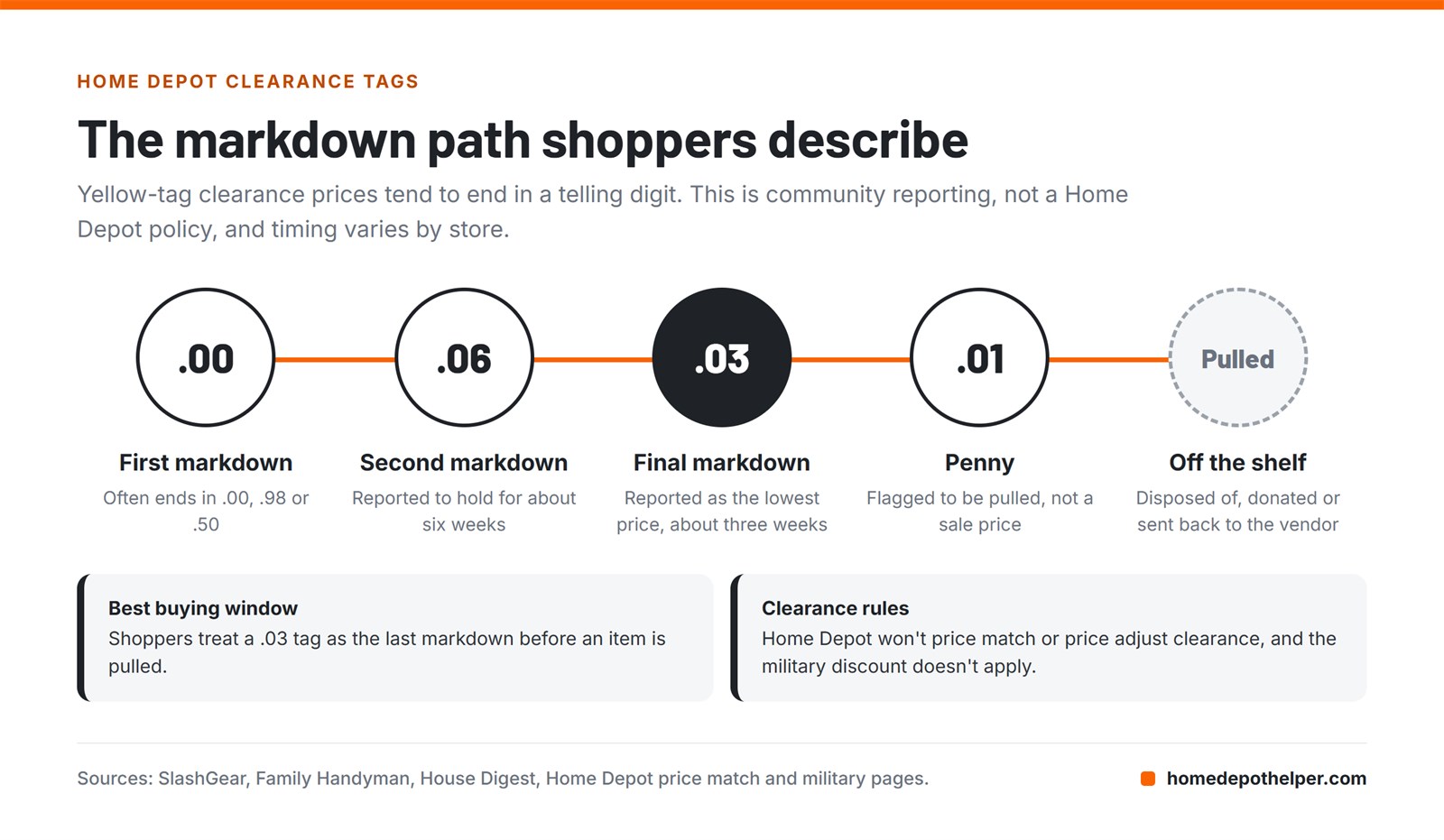
This is shopper knowledge rather than anything Home Depot publishes, but the major write-ups, including SlashGear’s January 2026 summary and Family Handyman’s tag guide, broadly agree on the pattern.
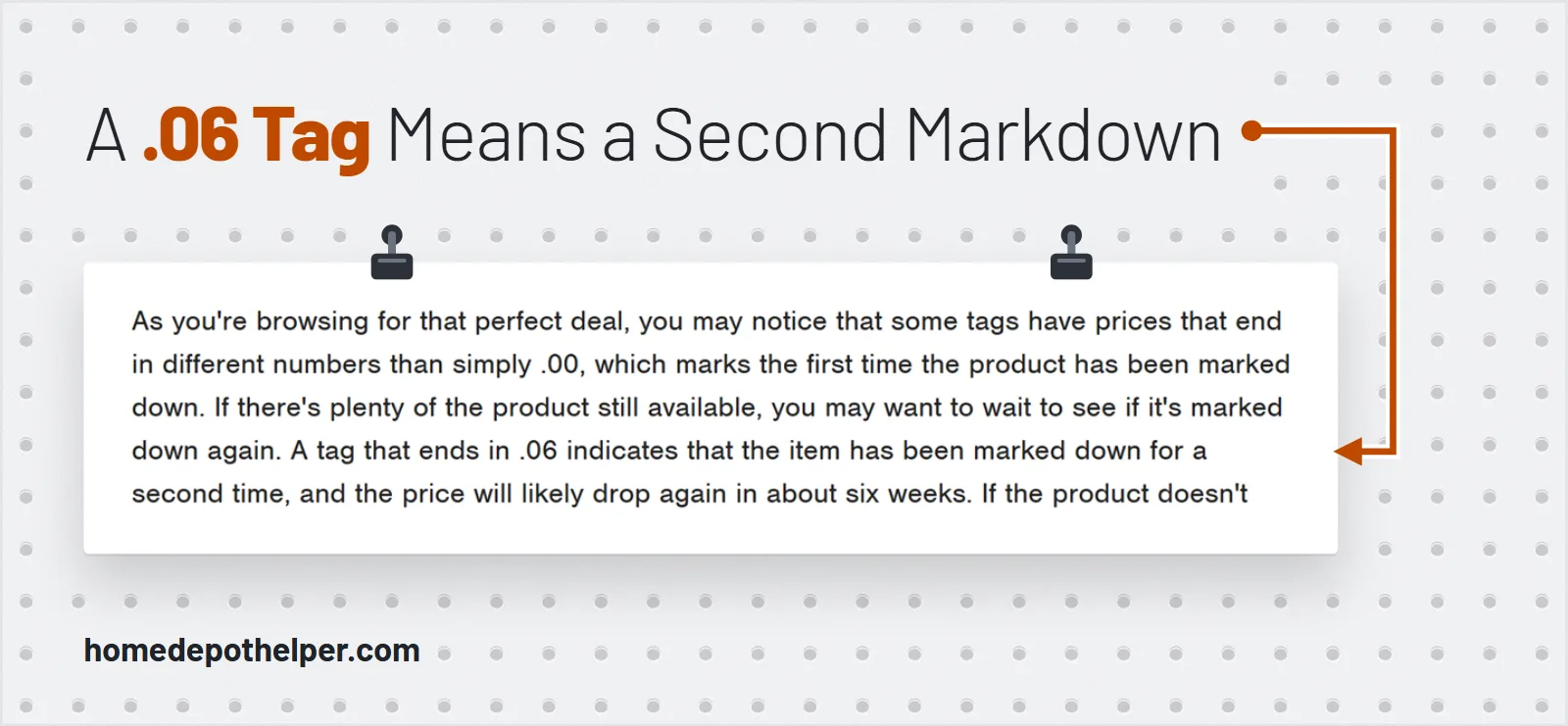
- .00, .98 or .50 usually marks the first markdown.
- .06 marks the second markdown, reported to hold for about six weeks.
- .03 marks the final markdown, reported to last about three weeks.
- .01 is the penny flag that means the item should already be gone.
Family Handyman’s own examples suggest the last digit is what counts, so a price doesn’t need to end in exactly .06 or .03. Its second markdown is a $39.99 tool cut to $16.36, and its final one is a $20.99 item at $3.53. Worked out from those prices, that’s about 59% and 83% off.
Here’s how I’d use it. A .06 tag on something you can wait for is a reason to check back in a few weeks, though the stock may be gone by then. A .03 tag on something you want is the moment to buy.
Taken together, the reported timings put about nine weeks between a .06 tag and the penny flag, six at .06 and three at .03.
Timing isn’t national either. Shoppers report that markdowns move store by store, so the same product can sit at .06 in one store and .03 in the next town.
Reading the Date on a Yellow Tag
The date printed at the bottom of a yellow tag is the other clue. ConsumerAffairs reporter Kyle James says it shows how long the item has sat at that price. When there’s plenty of stock and the tag is almost six weeks old, his advice is to wait a week for the next cut.
Run the reported timings forward from a .06 tag dated Oct 1 and the dates fall like this. They’re worked out, not published by Home Depot.
| Tag on the shelf | Next change on the reported timing |
|---|---|
| .06, dated Oct 1 | .03 around Nov 12 |
| .03, dated Nov 12 | Penny or pulled around Dec 3 |
Treat those dates as estimates. Any step can end early if the stock sells out or the store pulls it.
Where Clearance Turns Up in the Store
Clearance usually sits on the endcaps at the ends of aisles, Family Handyman notes, though marked-down items also get mixed in with full-price stock in their regular spot.
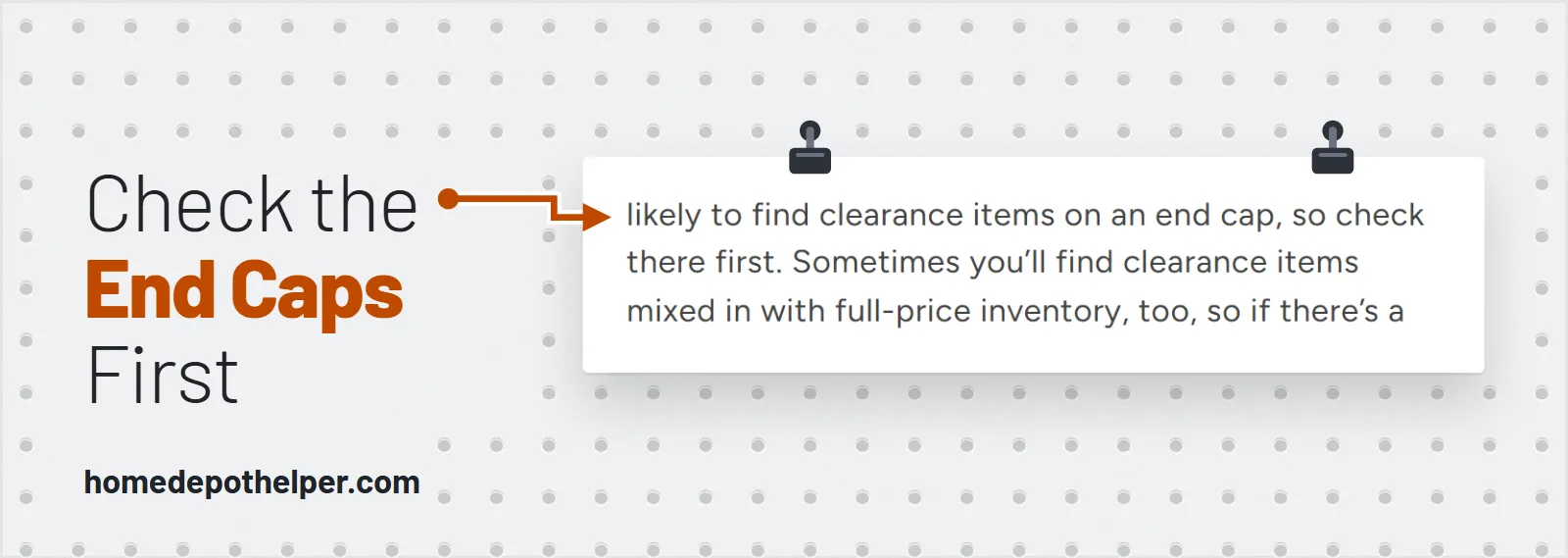
SlashGear’s advice is to shop early in the day, after overnight restocking, and on weekdays rather than busy weekends. Both tips cost nothing to try on a trip you were making anyway.
Rules Home Depot Does Publish for Clearance
Home Depot’s own pages say plenty about clearance, even if they say nothing about pennies. Its price match page describes clearance as discounted stock that’s often sold as final sale.
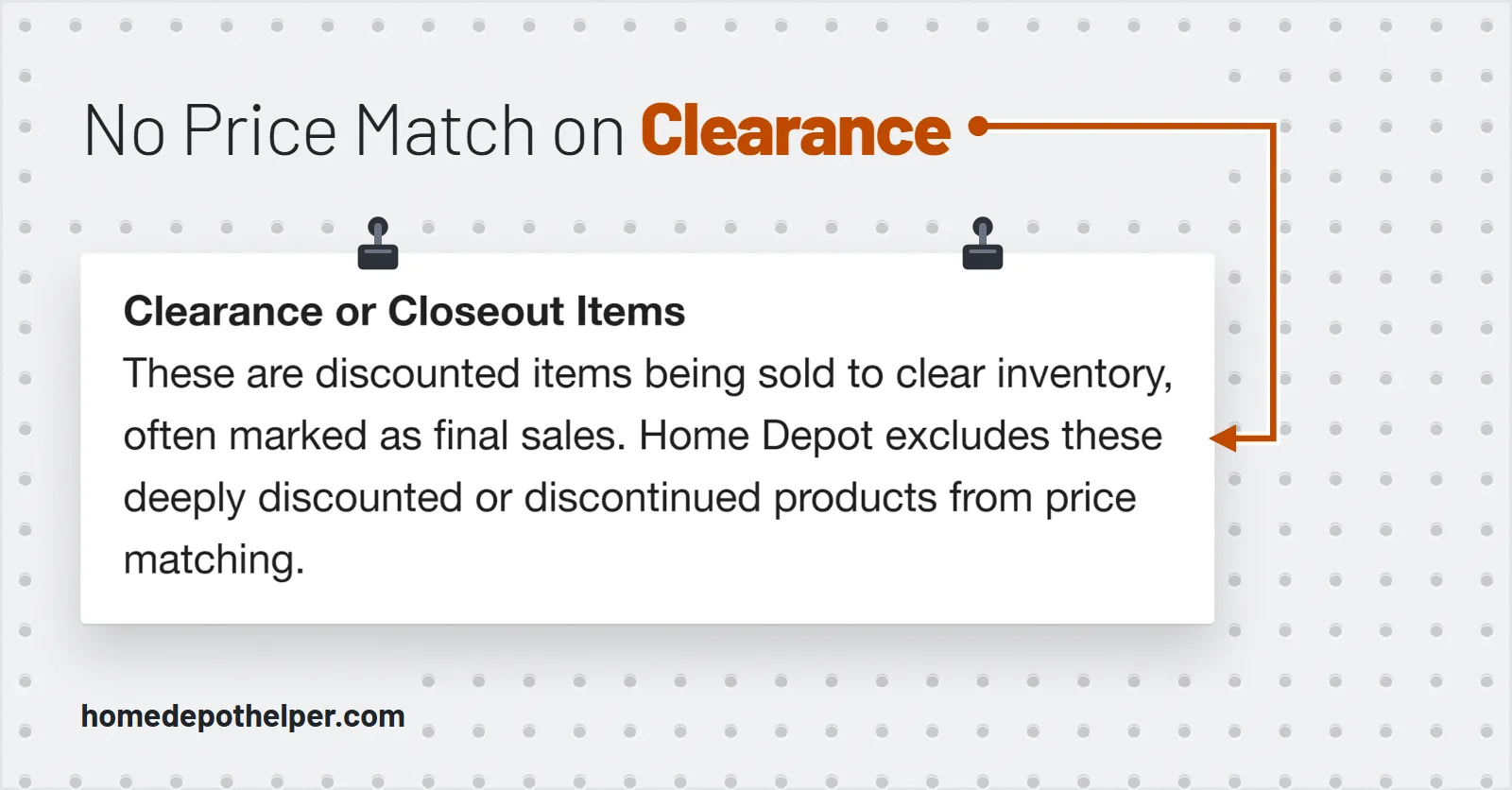
- Clearance can’t be price matched against another store.
- Clearance doesn’t qualify for a price adjustment if it drops further after you buy.
- The military discount doesn’t apply to clearance items.
Penny items fall outside all of this. With no published policy, there’s no adjustment, match or appeal for them.
Returns are the gray area. Clearance isn’t on the non-returnable list in Home Depot’s return policy, but a tag or receipt marked final sale settles it, so check before you buy something you’re unsure about.
Holiday decor has a shorter clock. SlashGear reported in August 2026 that decor bought at Home Depot now has to come back within 30 days, so a marked-down yard inflatable bought on Dec 26 would need to go back by about Jan 25. Other holiday deadlines are worked out under returning Christmas gifts.
Online and In-Store Prices
Home Depot’s price match page also says some products are priced differently online and in stores on purpose, and it won’t match those prices. Its example is a product discounted in one location but not online or in other stores.
That cuts both ways. A store’s clearance price may never show up online, and a lower online price won’t necessarily be matched at the register. ConsumerAffairs suggests a quick search in the Home Depot app while you’re in the aisle, then an online order with store pickup if the website is cheaper.
Where Penny Lists Come From
Penny lists circulate on couponing sites and social media, sometimes built from screenshots of Home Depot’s pricing software. They’re unofficial, and they tend to treat a markdown at one store as if it applied everywhere. A list that’s a week old is often out of date.
Most listed items are small and dull too. House Digest’s examples ran to septic tablets and candles, with the occasional ladder that makes a video go viral.
My Take on Penny Hunting
I wouldn’t drive across town for a penny item. The odds of finding one are low, the register can say no, and the time is better spent on the .03 tags in the aisle you were already shopping. Clearance hunting works best as a habit on trips you’re making anyway.
Real savings at Home Depot come from planned sales instead. The Black Friday sale dates are a better bet for big-ticket tools than any clearance hunt.